Marine animal microbiomes
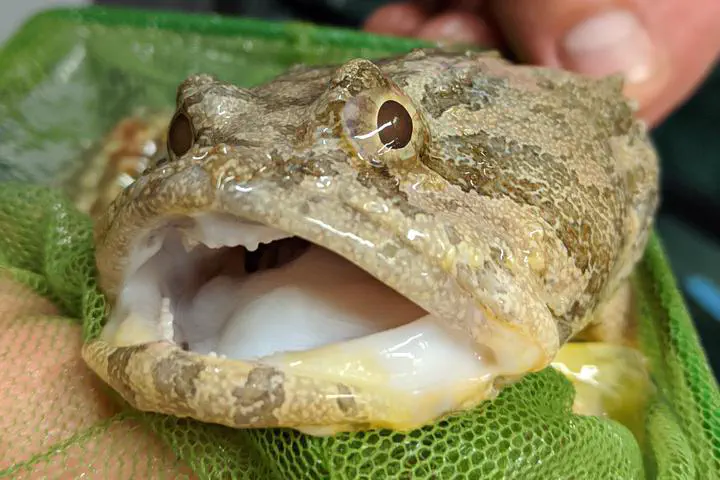 Photo by Martin Grosell
We study the microbial communities associated with marine model organisms, combining metabarcoding, genomics, and transcriptomics to understand how microbiomes contribute to host physiology and the broader ocean carbon cycle.
Biomineralisation in the Gulf Toadfish microbiome
Marine teleost fish precipitate CaCO₃ in their intestines as part of their osmoregulatory strategy, a process that may account for up to 15% of total calcium carbonate deposition in the ocean. Despite its significance, the molecular mechanisms driving this reaction remain unknown — no candidate genes have been identified in the fish genome or transcriptome of the Gulf Toadfish (Opsanus beta), the primary model for studying this process.
We are testing the hypothesis that gut microbiota — rather than the fish itself — are responsible for intestinal carbonate precipitation. Bacteria are well-established agents of calcium carbonate deposition in marine environments, and their role in analogous processes (such as kidney stone formation) has been documented in mammals. Using a combination of 16S/18S metabarcoding, metagenomics, and transcriptomics, we are characterising the microbial communities of the toadfish gut and identifying candidate bacteria driving CaCO₃ deposition. Understanding this process is critical for accurate modelling of ocean carbon dynamics and for exploring marine microbiome-based carbon sequestration strategies.
Key publications
Oehlert AM, Garza J, Nixon S, et al., including Javier del Campo & Grosell M (2024). Implications of dietary carbon incorporation in fish carbonates for the global carbon cycle. Science of the Total Environment, 916, 169895.
Preprint: Symbiotic bacteria support calcium carbonate precipitation in the Gulf Toadfish gut. bioRxiv (2025).
The microbiome of the California sea hare
 Photo by Elizabeth Whitson
The California sea hare, Aplysia californica, is a well-studied model organism in neurobiology and neuroscience. Despite deep knowledge of its physiology, anatomy, and ethology, little is known about its microbiome. In collaboration with the National Resource for Aplysia at the Rosenstiel School of Marine and Atmospheric Science, we are exploring for the first time the prokaryotic and microeukaryotic communities associated with this organism using a genomic, metabarcoding approach. These data will allow us to investigate how the microbiome influences behaviour, ageing, and other characteristics of this important model animal.
Javier del Campo
Group Leader
My research aims at understanding the global diversity and distribution of eukaryotic and prokaryotic microbes employing curated phylogenetic frameworks focusing on novel environmental taxa.