New paper in Microbiome: Coral bleaching, cell by cell
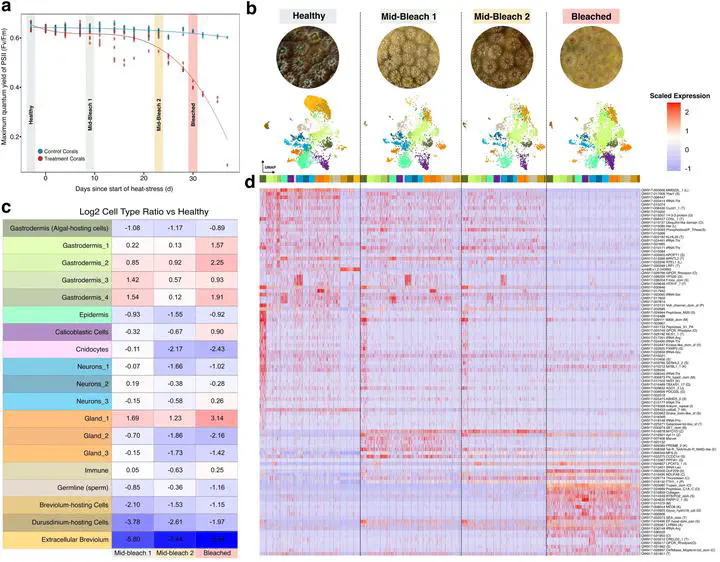
Our latest paper, led by Anthony Bonacolta and published in Microbiome, delivers the first single-cell transcriptomics of a bleaching coral and shows how the host, its two algal symbionts, bacteria, and protists all shift together as the symbiosis breaks down. 🪸🔥🦠
We are thrilled to share our latest publication in Microbiome!
Single-cell ecology of coral-algal symbiosis breakdown
Bonacolta AM, Snyder GA, Karp RF, Yeager E, Wen ADE, Dennison CE, Nonell-Remedios J, Traylor-Knowles N, Baker AC, del Campo J (2026). Single-cell ecology of coral-algal symbiosis breakdown. Microbiome.
Coral bleaching looks like a reef-scale catastrophe, but it starts as a breakdown between single cells. While we know a great deal about how whole corals respond to heat stress physiologically and genomically, the cellular conversation between the coral host, its algal symbionts, and the rest of the microbiome has remained largely out of view. This study brings it into focus.
We heat-stressed the Caribbean coral Orbicella faveolata, which hosts two co-dominant symbionts (Durusdinium and Breviolum), and combined single-cell RNA sequencing with 16S, 18S, and ITS2 metabarcoding and photochemical measurements to follow the whole holobiont through bleaching.
Key findings:
- The two symbionts responded differently to heat stress, especially in transcripts involved in nitrogen cycling.
- Coral gastrodermal cells showed an apparent suppression of heat-stress genes that depended on which symbiont they carried. Bleaching is not one process; it is many, cell by cell.
- Mucocytes (mucus-producing gland cells) expanded under heat stress and appear to play an active role in the bleaching response.
- For the first time, we watched bacteria and microbial eukaryotes shift together during bleaching: suspected nitrifiers dropped early, while suspected denitrifiers and nitrate reducers rose, alongside blooms of chlorophytes, diatoms, and labyrinthulids.
The take-home message is that the holobiont is the unit of coral health: host, symbionts, bacteria, and protists, all interconnected. To make the data useful beyond this paper, the team also built a web app where anyone can explore the microbiome and single-cell datasets for their own microbes or genes of interest.
This was the final chapter of Anthony’s PhD, and we could not be prouder. Huge congratulations to Anthony, to Jordi Nonell (our resident computer guy), and to all co-authors at the Rosenstiel School and IBE, including the cnidarian FACS experts, the coral husbandry wizards, and the reviewers who helped this work grow since the preprint two years ago. 🎉
This work was supported by University of Miami start-up funds, Grant PID2023-152522NB-I00 (MICIU/AEI and ERDF, EU), the University of Miami Maytag Fellowship, and NSF grant OCE-1851392.
Javier del Campo
Group Leader
My research aims at understanding the global diversity and distribution of eukaryotic and prokaryotic microbes employing curated phylogenetic frameworks focusing on novel environmental taxa.