New paper in Cell Host & Microbe: Temporal rhythms govern coral holobiont function
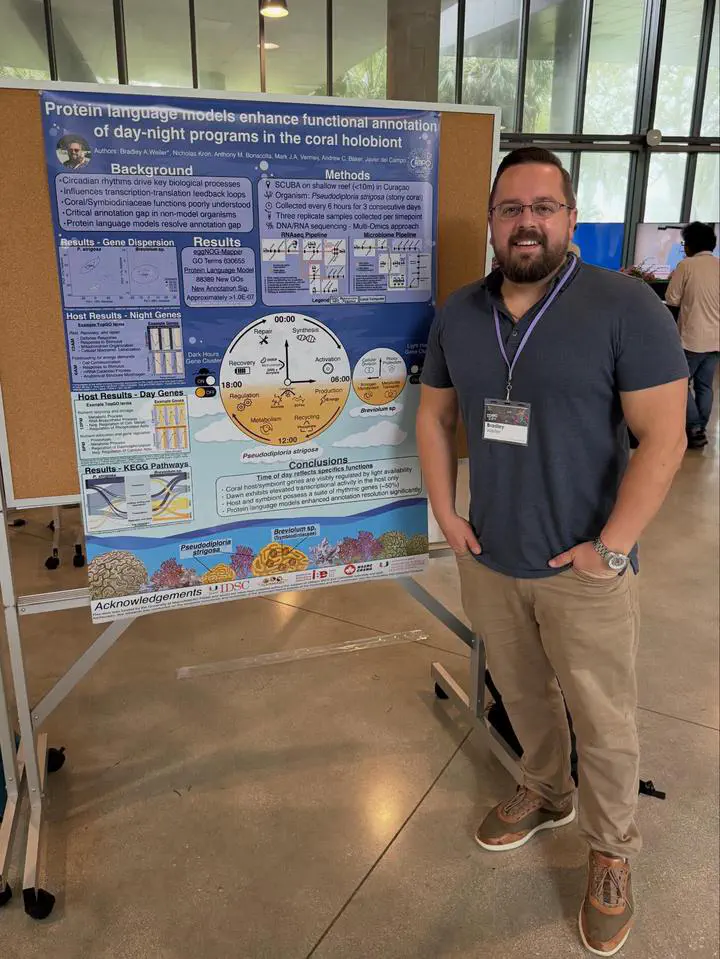
Our lab’s latest paper, led by Brad Weiler and published in Cell Host & Microbe, reveals how the day-night cycle orchestrates the entire coral holobiont as an integrated system. 🪸🦠🧬
We are thrilled to share our latest publication in Cell Host & Microbe!
Temporal transcriptional rhythms govern coral-symbiont function and microbiome dynamics
Weiler BA, …, del Campo J. Cell Host & Microbe 34, 304–323 (2026). DOI: 10.1016/j.chom.2026.01.004
Corals don’t simply react to their environment — they anticipate it. Diel (day-night) cycles drive predictable rhythms in physiology, and this study provides the first system-level molecular framework of how those rhythms play out in situ across all components of the coral holobiont simultaneously.
Brad Weiler, then a PhD student at the Rosenstiel School of Marine, Atmospheric, and Earth Sciences (University of Miami) and now a Postdoctoral Fellow at NOAA, led a remarkable field campaign at the CARMABI Marine Station in Curaçao: sampling the stony coral Pseudodiploria strigosa every 6 hours over 3 days of continuous diving — no small feat! The team integrated host and Symbiodiniaceae (symbiont) transcriptomics with microbiome dynamics to build an unprecedented picture of diel regulation in a coral reef environment.
Key findings:
- The coral host shows clear time-of-day-specific gene expression: dawn is dominated by cellular activity and photosynthetic preparation, dusk by immune signalling, and midnight by cellular maintenance and repair.
- The symbiont Breviolum follows its own coordinated rhythm, with peak metabolic complexity during daylight and a shift toward cellular maintenance at night.
- Despite the dramatic diel fluctuations in the surrounding reef environment — oxygen swings, light pulses, temperature changes — the coral microbiome remains remarkably stable across the cycle.
- Taken together, the holobiont functions as a tightly integrated system, with each partner contributing distinct and complementary functions at predictable times of day.
This work was funded by the University of Miami and NSERC PGSD, and was made possible by the support of UMiami, Institut de Biologia Evolutiva (CSIC-UPF), and the scientists and staff of the CARMABI Marine Station.
Huge congratulations to Brad and all co-authors — and a special nod to the resilience required to pull off three days of round-the-clock reef diving! 🤿
Javier del Campo
Group Leader
My research aims at understanding the global diversity and distribution of eukaryotic and prokaryotic microbes employing curated phylogenetic frameworks focusing on novel environmental taxa.